
Examples of Enhancing Treatment & Care with Hyperbaric Oxygen Therapy (HBOT): Complete Global Ischemia Associated with Cardiopulmonary Arrest (Suspected Mycotoxin Exposure)
A 5-month-old female intact Border Collie was referred with a history of presentation to an overnight emergency center for an acute onset of intractable cluster seizures.
The puppy lived in a rural setting with free access to a horse barn. The first attending emergency clinician used multiple drugs in an attempt to control the seizure cluster. Intubation was achieved, and CPR was successful. The puppy was manually ventilated for 20 minutes until spontaneous respirations returned. However, the puppy remained non-responsive with no pupillary light reflexes or doll’s eye responses. Several hours later the puppy was referred to a 24 hour critical care center by the primary care veterinarian, and was transferred directly from the overnight emergency hospital.
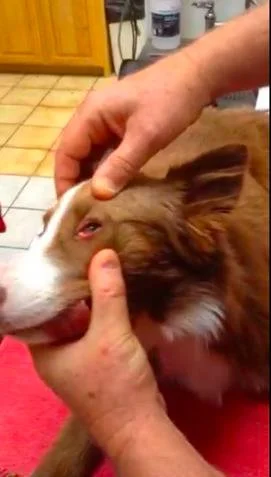
The puppy presented laterally recumbent and non-responsive with no pupillary light reflexes or doll’s eye responses. Spontaneous respirations were present (image at left).
The puppy had recurring semi-formed stools of a strong, sweet odor, containing a large amount of undigested grain and hay material. Mycotoxin intoxication was suspected. The owner also reported an empty vial of phenylbutazone was found in the barn, and that raccoons were recently suspected of breaking into various containers in the barn closet.
Blood tests revealed mild increases in GGT and Na, with mild hypokalemia. Blood glucose levels were repeatedly normal. Supportive fluid therapy was continued. IV naloxone and oral acetylcysteine were given.
SCHEDULE OF HBOT
9/18/14 – Two sessions for one hour each at 1.5 ATA
9/19/14 – Two sessions for one hour each at 1.5 ATA
Hyperbaric oxygen sessions were performed at 1.5 ATA for one hour twice daily. The puppy was able to swallow, drink, and eat after the first session, and then stand and walk as she exited the chamber after the second session.
HBOT was continued twice daily on day two of hospitalization, and patient was discharged for care at home later that day at the owner’s request. No further seizures were reported, and follow up one week later revealed a normal physical and neurologic examination.
Chapter 19 in the 5th edition of KK Jain’s “Textbook of Hyperbaric Medicine” summarizes the findings of 33 studies where HBOT was employed in models of complete global ischemia. 31 of the 33 studies showed positive results in the groups who received HBOT (pages 236-274).
© RKLyman, LLC. All Rights Reserved.