Wobbler Syndrome Surgical Consult
REQUEST FORM
Dr. Jay McDonnell is offering consultations for MRI-diagnosed Wobbler Syndrome patients to determine if they are a candidate for the revolutionary Cervical Arthroplasty with Artificial Disc — a surgical procedure pioneered by Dr. Fillipo Adamo.
Unlike traditional stabilization techniques, this approach maintains vertebral motion while relieving spinal cord compression. The procedure has demonstrated excellent outcomes with rapid recovery and return to function, and Dr. McDonnell was the first veterinary neurosurgeon in the Mid-Atlantic region to perform this surgery.
To be eligible for this opportunity, the patient MUST have an MRI-confirmed diagnosis of dynamic cervical spondylomyelopathy (Wobbler Syndrome).
This over-the-phone consultation is just $75 for eligible patients. If your patient is experiencing neck pain but their diagnosis has not yet been confirmed by MRI, please book a regular neurology consult instead.
If you are the referring veterinarian, please send relevant patient records and MRI results to questions@vnioc.com.
Questions about this process?
Call us at (410) 828-0911 ext 5
Treating Wobbler Syndrome with Cervical Arthroplasty with Artificial Disc
Originally developed by Dr. Filippo Adamo in California, the cervical arthroplasty procedure replaces a cervical disk with an artificial titanium one. This procedure shows excellent results with rapid recovery and return to activity and disc replacement is superior to other surgical procedures such as a ventral slot or rigid stabilization. VNIoC’s own Dr. Jay McDonnell was the first veterinary neurosurgeon in the mid-Atlantic area to perform this surgery.
The cervical arthroplasty surgery involves removing the diseased disk under distraction and placing the artificial disk. The distraction is released and the disk is retained in the disk space. The disk is made from titanium for strength and decreased magnetic artifact (MRI). Two pieces articulate by a ball and socket mechanism and allow 30 degrees of movement.
After the damaged disc is removed, a slot is created in the surrounding vertebrae, then the titanium artificial disc is put in place, keeping the vertebrae separate while allowing normal movement. This is in contrast to disc fusion, which can transfer stress to surrounding areas, causing further damage along the spine.
Not only do we feel this surgery provides a better outcome for Wobbler Syndrome than the traditional surgical approach; it is less invasive, requires minimal post-op care and hospitalization, reduces post-op pain and discomfort, has a lower mortality rate, and has a lower cost to the owners.
Other surgical options for Dynamic Wobbler Syndrome (DAWS) often require long post-operative recovery and follow-up cast care. There is also the risk of “domino lesion,” in which an adjacent intervertebral disk space becomes affected. Similar to a relatively new surgery for back pain in humans, cervical arthroplasty using the artificial disc system treats the disease in a more physiological and biomechanically sound manner and prevents domino lesions — as the implanted disc provides immediate distraction and maintains mobility at the site, making the development of a new lesion at an adjacent site less likely.
Some dogs that are ambulatory when they come in can be operated and discharged the next day. Ultimately, most dogs return to full normal function after this surgery. VNIoC has even treated an active agility dog that was able to return to competition just 2 months after his Adamo-disc surgery.
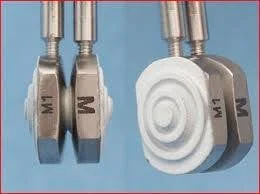
This is the complete Adamo Spinal Disc implant. The light-weight disks are made from surgical-grade titanium. The white material on the back of the implants promotes bony fusion between the vertebrae and the implant. The two disks articulate like a ball and socket to allow the two parts of the disk to move relative to one another.
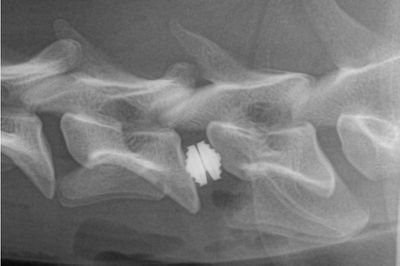
Lateral radiograph (x-ray) of a dog's neck showing placement of artificial disks between the 5th and 6th cervical vertebrae. This two-piece articulating disk replaces the diseased disk, maintains distraction (spacing) of the disk space, and allows the two vertebrae to continue to articulate (move) naturally.
Max: A Wobbler Syndrome Case Study
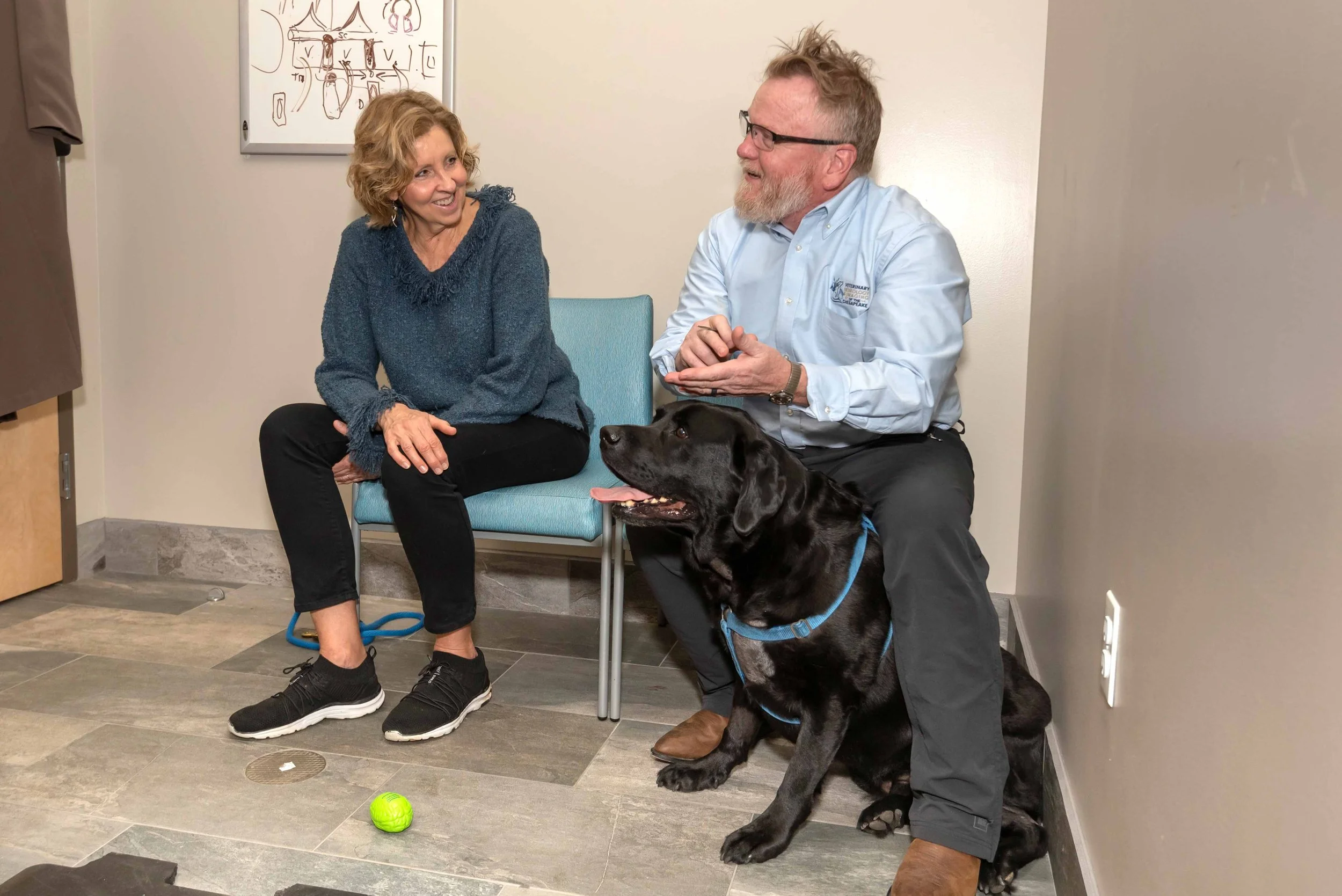
Six-year-old Max is “a big, beautiful, goofy black Lab,” who is adored by his two humans. Athletic like most Labs, Max is also injury-prone. A year previous, he suffered a neck injury so when Max fell down the steps, the local ER veterinarian near their home in Delaware recommended going to VNIoC for a full work-up, which would include an MRI.
When Max’s parents brought him to VNIoC for the consultation, we immediately noticed gait and reflex abnormalities, which led us to suspect a spinal cord problem. The MRI showed disc-associated Wobbler syndrome (DAWS) involving his C5-6 disk space, which caused compression and gliosis of the spinal cord. Dr. McDonnell proposed performing cervical disk replacement using a titanium artificial disc — a procedure developed by Dr. Filippo Adamo.
Given Max is young and very active, he likely would re-injure his neck so his owners decided to have Dr. McDonnell operate — as it seemed the best option for Max long-term. Max, like most dogs, returned to full normal function after his surgery.