
Examples of Enhancing Treatment & Care with Hyperbaric Oxygen Therapy (HBOT): Extreme Anemia in a Three-Week Old Puppy

A three-week old female puppy was presented and admitted as an evening emergency. The puppy had been adopted one week earlier, and was being hand fed liquid puppy formula by syringe. The owners reported progressive lethargy. Physical exam revealed a laterally recumbent, weak puppy with pale mucous membranes and melena. Respirations were rapid. The puppy weighed half a pound, and the rectal temperature was below the range of the thermometer.
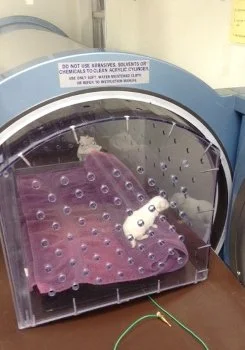
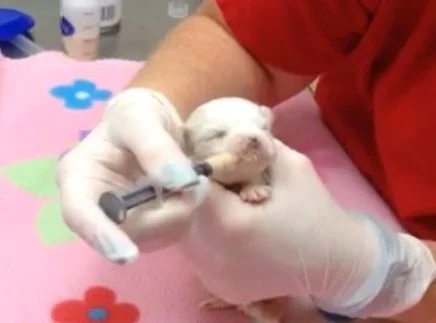
PCV at admission was 9%. Blood glucose was normal. The puppy received a 6cc fresh whole blood transfusion, and was given one hyperbaric oxygen therapy session at 1.5 ATA for one hour. By the session’s end, the puppy was ambulatory, with a reduced respiratory rate (above left), and able to willingly take syringe feedings of formula (above right). Emperical deworming with fenbendazole was initiated. The puppy was discharged and transferred to the care of her primary care veterinarian by morning.
Transfusion alone may not be adequate to reduce the oxygen debt
In 1964 Crowell demonstrated that severe oxygen debt resulting from exceptional anemia resulted in the death of canine subjects in his study (Crowell, JW et al, “Oxygen Deficit and Irreversible Hemorrhagic Shock”, Am J Physl, 1964:206:313-16).
In 2005 Van Meter published a review demonstrating that HBOT is effective at reducing this oxygen debt, and is beneficial in the treatment of severe anemia. (Van Meter, K.W., “A Systemic Review of the Application of Hyperbaric Oxygen in the Treatment of Severe Anemia, An Evidence Based Approach”, UHM, 2005, Vol 32, No 1).
In his review, Van Meter noted that the use of blood transfusions is based on clinical practice experience, and not on evidence based studies.
© RKLyman, LLC. All Rights Reserved.