
HBOT Safety/Review Questions #8

You are treating a particularly active MN Toy Poodle with adjuvant HBOT for a non-healing wound.
You have initially chosen treatment pressures of 2.0 ATA. This little guy tends to run around in circles within his treatment module during treatments. Will he have an increased risk or decreased risk of CNS oxygen toxicity with all this exercise? Will he have an increased or decreased risk of static formation? Please discuss, and suggest your various options in this situation.
ANSWER: The exercise will likely give him both an increased risk of oxygen toxicity and increased risk of static electricity formation (Reference, Koch, Koch, et al, "Physical exercise might influence the risk of oxygen induced neurotoxicity" UHM 2013, Volume 40, No. 2, GPS 155-163). Your options include:
Reducing treatment pressure to 1.5 ATA in order to reduce oxygen levels in the CNS tissue;
Consider a sedative combination to include a benzodiazepine such as midazolam, which has anticonvulsant activity as well;
Give short oxygen breaks during the sessions, by switching to medical grade breathing air for several minutes at a time once or twice during treatments.
If a seizure does occur during treatment, a switch to medical breathing air can be made without a reduction in pressure to lower CNS tissue oxygen tension. In any event, be sure to always have in place the grounding plate within the treatment module in order to reduce static formation.
Intestines or stomach filled with gas should be expected to do which of the following during treatment with HBOT?
Increase in volume during the treatment session.
Decrease in volume during the treatment session.
Remain unchanged in volume during treatment session.
ANSWER: 2. Decrease in volume during the treatment session while "at pressure". Boyle's Law dictates that when the pressure increases the volume of the intestinal gas will decrease, and thus intestinal blood flow will increase. In accordance with Dalton's Law, the increased pressure during HBOT will also result in enhanced diffusion of inert gases from the lumen into the blood. When the intestinal loops are distended with gas (thus reducing the blood flow through intestinal micro circulation), HBOT will also result in increased oxygenation of the hypoxic intestinal tissue as described in the modified Krogh-Ehrlang model for oxygen diffusion. (Reference, Kindwall and Whelan, Hyperbaric Medicine Practice, Best, Second Edition Revised, page 931). In Japan, Ileus was the first indication for adjuvant HBOT "approved" in human medicine.
Name the approved type of fire extinguisher for HBOT chamber facilities. How often should it be serviced?
Check to see if your extinguisher is readily accessible and "in date."
ANSWER: The preferred extinguishing agent for hyperbaric chambers is water. Water reduces heat in the fuel, and thus inhibits both ignition and combustion. Gaseous extinguishers containing CO2 or Nitrogen, whose primary action is to inhibit oxygen concentration, are much less effective in the face of a nearly pure oxygen environment. Chemical fire extinguishers are also less potent in the face of a high oxygen concentration, and may result in the production of toxic combustion products in an enclosed environment (Reference, Workman, WT, Hyperbaric Facility Safety, A Practical Guide, Best Publishing, 1999, page 516). Extinguishers should be regularly serviced according to local code requirements.
You receive by referral a middle aged F/S Schnauzer with severe pancreatitis.
The patient's primary care veterinarian has specifically directed the client to your hospital for adjuvant HBOT along with traditional supportive treatment. The owner writes in the "previous illness" area of the admitting information form that this patient had a pacemaker implanted 2 years ago to treat "sick sinus syndrome." Is this patient a candidate for HBOT? Please discuss your response.
ANSWER: In terms of the pacemaker itself, there should be no concerns with HBOT and pressure issues. Pacemakers produced after the 1960's are routinely tested at pressure (Reference Kindwall and Whelan, Hyperbaric Medical Practice, Second Edition, Best, 2004, page 88). Consultation with the manufacturer on this testing can be obtained to reassure an owner. It is advisable to take a current thoracic radiograph to rule out occult pneumomediastimum / pneumothorax in these patients prior to HBOT.
You are treating a canine patient for sepsis with adjuvant HBOT.
The technician supervising the session notes that the acrylic window (or porthole in the case of a metal chamber) is fogging heavily during the session. Please discuss the potential cause(s), and how to proceed.
ANSWER: Excessive fogging of the acrylic tube, treatment module, or porthole may signal that the oxygen flow rate of the chamber is too low, or that the patient is overheated. Close attention to the patient's respiratory rate and demeanor is indicated. Check the oxygen sensor to assure that the oxygen percentage in the chamber is in the mid to high 90's. Increase the flow rate of the chamber and see if that will reduce or clear the fogging. If there is any suggestion that the patient is uncomfortable or the respirations are inappropriately increased, start an early, normal decompression at a high flow rate and notify the attending doctor. Take the rectal temperature of the patient immediately upon exit from the chamber and report this to the doctor. Have the oxygen delivery system and "in-line" filters inspected.
If a seizure is observed while a patient is in the chamber it is advisable to reduce treatment pressure AFTER the major motor activity ends, and to notify the attending doctor.
Please explain another option if your chamber has an alternative supply of "medical breathing air."
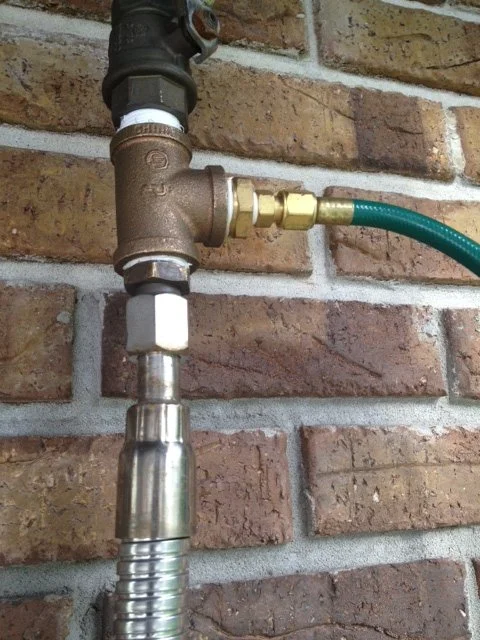
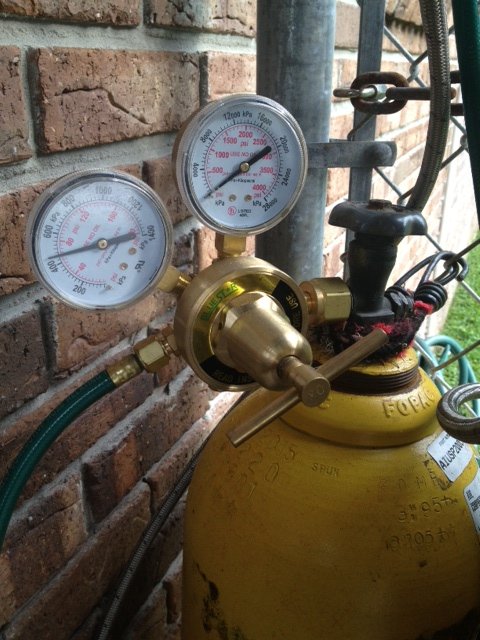
ANSWER: If your chamber has a supply of "medical breathing air" (in addition to oxygen), you may switch over to this supply immediately if a seizure occurs during an HBOT session, WITHOUT reducing the treatment pressure. The effect will be to reduce the percentage of oxygen in the chamber, and thus in the brain of the patient being treated, without immediately reducing the chamber pressure. This can be done as soon as a seizure is recognized by opening the supply of medical breathing air (images below) and closing the supply of 100% oxygen. The attending doctor should be immediately consulted as to the plan for the remainder of the treatment session. After the seizure ends it is possible to continue the treatment session at a lower pressure and resume the 100% oxygen supply, or to gradually and normally terminate the treatment session using medical breathing air or 100% oxygen.
Which of the following should be performed on a daily basis on your hyperbaric chamber?
Clean the hair and dander from the bottom of the chamber.
Calibrate the oxygen monitor.
Check the connections on all grounding plates.
Clean all treatment modules and the chamber itself with a soapy water solution and dry with a 100% cotton towel.
All of the above.
ANSWER: 5. All of the above
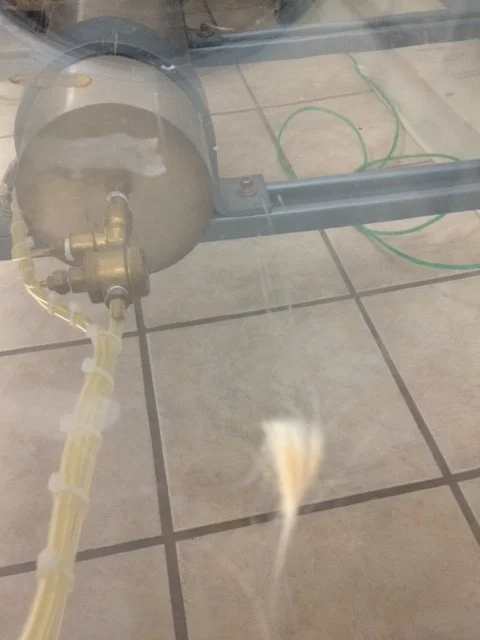
The chamber must be clean and free of all sources of combustible materials like hair and dander, which tend to accumulate on the bottom, below the gurney or tray (image). The grounding accessories are necessary to inhibit static electricity development and discharge, and the oxygen monitor assures effective and safe therapy.
You are about to place a gastric feeding tube in a cat with severe thermal burns.
You plan to treat this cat with adjuvant HBOT to speed healing of its wounds and assist in pain management. Which type stomach tube should you NOT select to use if the patient will be treated with HBOT, and why?
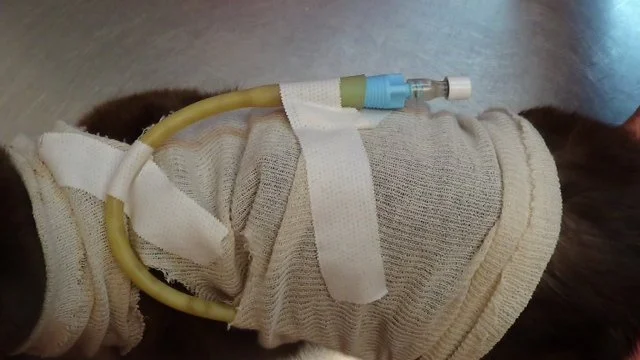
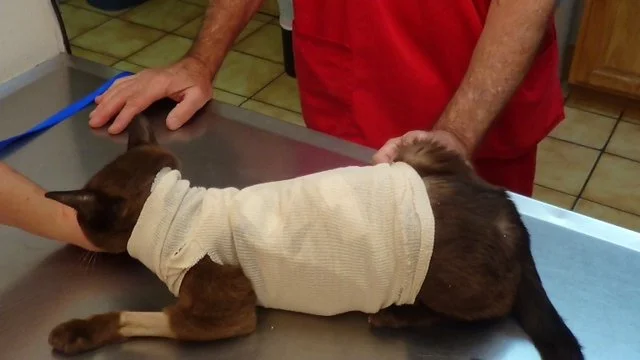
ANSWER: You can add another layer of 100% cotton stockinette over the tube. This will effectively cover the polyethylene or silicon tube with a layer of cotton (see image below). Remember, the rule of thumb: Anything other than the patient itself shall be covered with 100% cotton. The adjuvant HBOT modulates the genetic inflammatory response, shifting it toward the anti-inflammatory expression. This is especially useful in clinical processes such as "Triaditis". Measurements of human tissue cultures in vitro demonstrate changes in MRNA levels of inflammatory genes after HBOT (Reference, Kendall et al, UHM 2013, Volume 40, number 2, GPS. 115-123, Different oxygen treatment pressures alter inflammatory gene expression in human endothelial cells).
You have two patients in separate modules during an HBOT session.
Which circumstance below is an absolute indication for beginning a normal, gradual, but premature conclusion to the treatment session?
One patient, a cat, pulls off the ground wire connection on the grounding plate in his module and continues to chew on the wire without stopping.
One patient urinates in the module.
One patient defecates in the module.
One patient vomits in the module.
None of the above.
ANSWER: 1. One patient, a cat, pulls off the ground wire connection on the grounding plate in his module and continues to chew on the wire without stopping.
A gradual decompression should be started if a patient begins to act in a manner which may cause self harm or injury. In this case, we do not want the cat to swallow a piece or pieces of the wire and create a GI foreign body, or injure his mouth on the wire. The other answer options are not absolute indications for premature termination of a treatment session, and can usually be cleaned up after the session.
You are treating a canine with complete global ischemia secondary to cardiopulmonary arrest.
He is known to be a well-controlled idiopathic epileptic. His body temperature is below normal. Will the low body temperature increase or decrease the chance for CNS oxygen toxicity and seizures during an HBOT session?
ANSWER: A patient with a low body temperature will have a reduced chance for oxygen toxicity and thus oxygen induced seizures (Reference Kindwall and Whelan, Hyperbaric Medicine Practice, Second Edition Revised, Best, 2004, page 76). Conversely, elevated body temperature increases the possibility of oxygen toxicity.