
Examples of Enhancing Treatment & Care with Hyperbaric Oxygen Therapy (HBOT): HBOT in the Treatment of a Non-Healing Dog Attack Wound
An adult greyhound was presented with the complaint of a non-healing wound on the caudal and lateral aspect of the left thigh (see image below left). The wound was the result of a bite by another canine, and had been managed with antibiotics and wet to dry bandages without success over the past several weeks prior to referral. The femur was exposed, and the remaining muscle tissue was largely devitalized, with minimal granulation tissue on the wound margins. Due to financial concerns, the owner was only able to present the patient for HBOT sessions as an outpatient sporadically over a 6 week period.
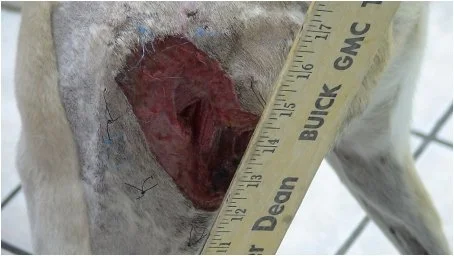
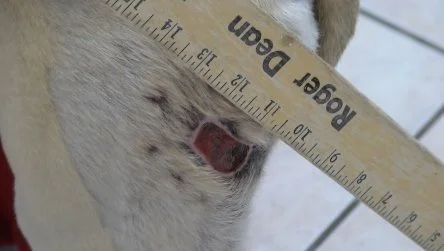
Above left: Wound presentation prior to HBOT. Above right: Wound presentation after 18 sessions of HBOT.
Antibiotics were continued, an E collar was employed, and daily hydrotherapy was initiated. One hour HBOT sessions were begun at 2 ATA. Granulation tissue proliferated, and wound closure commenced. Six weeks later and a total of 18 one-hour HBOT sessions, the wound became superficial and less than one inch in diameter at this point. The owner elected to discontinue HBOT and allow granulation to continue without further therapy (see image above right).
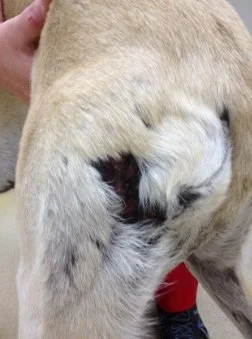
The image at right was obtained two months after
HBOT was discontinued; the wound had closed.
This case illustrates how HBOT can enhance
healing even when employed sporadically due to
financial or logistical concerns. Evidence-based
medicine demonstrates that adjunctive HBOT is
beneficial in wound healing.
(Reference, Goldman RJ, “Hyperbaric Oxygen Therapy for Wound Healing and Limb Salvage: A Systemic Review”, Physical Medicine and Rehabilitation. 2009:1:471-489).
© RKLyman, LLC. All Rights Reserved.